
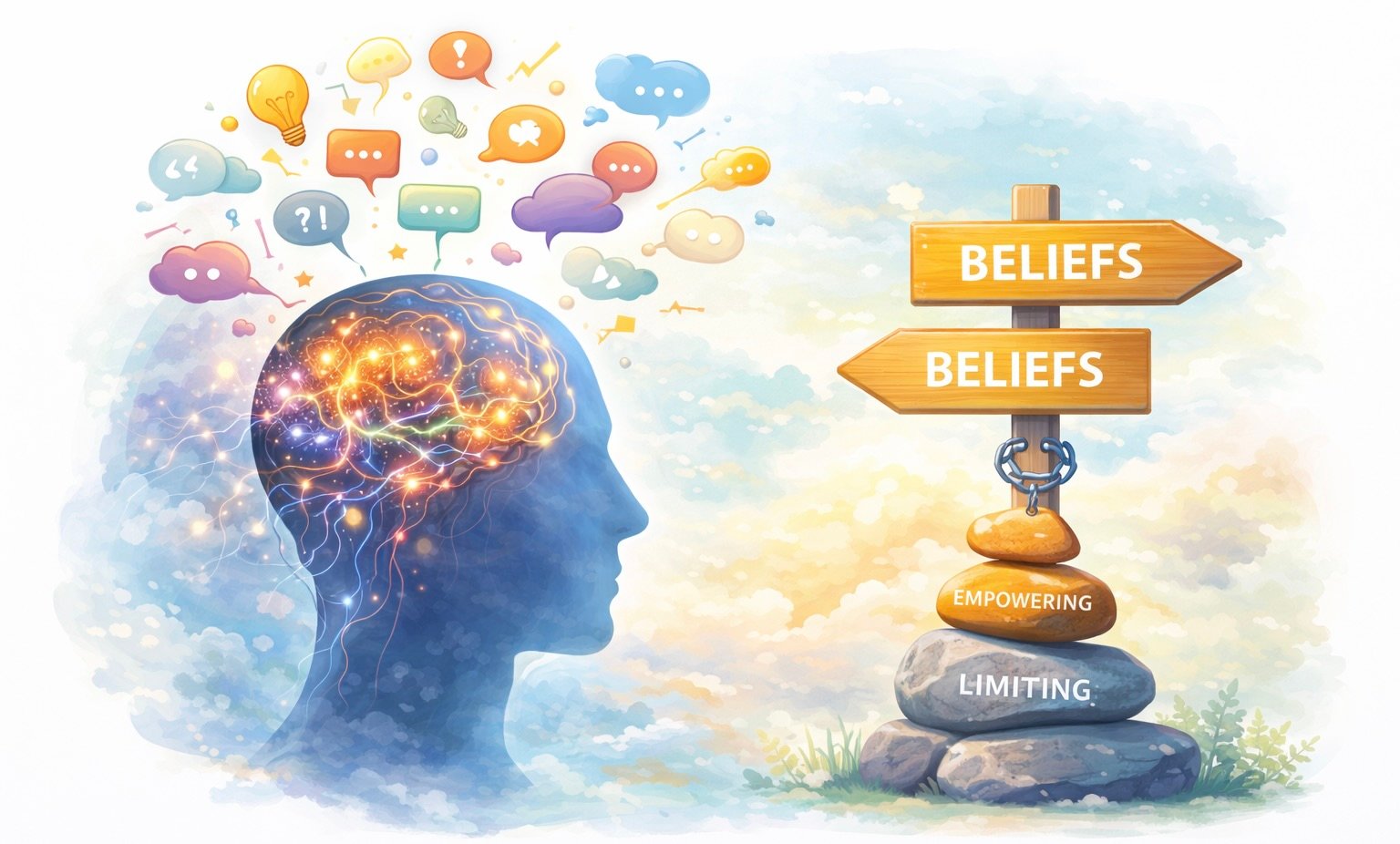
Human experience is continuously shaped by thought. Research in psychology and neuroscience suggests that the mind generates tens of thousands of thoughts each day, many of which occur automatically and outside conscious awareness. Whether or not one focuses on the exact number, what matters is the impact: a significant amount of mental energy is spent processing inner activity every waking moment.
This constant mental movement influences attention, emotion, perception, and behaviour—often without us noticing it.
How Thoughts Arise
From a scientific perspective, thoughts are associated with electrochemical activity in the brain. Neurons communicate through electrical impulses and chemical signals, supported by metabolic energy derived from glucose or ketones. As one explores this level of explanation, the mechanisms quickly become complex and highly specialised.
From an experiential perspective, thoughts can also be understood as mental impressions—subtle patterns that arise, move, and dissolve within awareness. These impressions are often shaped by emotional states, past experiences, and sensory input. The mind translates them into language, images, or narratives so that experience becomes interpretable and meaningful.
Both perspectives describe the same phenomenon through different lenses. One explains how thoughts occur biologically; the other explores how they are experienced internally.
The Relationship Between Thoughts and Emotions
Thoughts do not arise in isolation. They are closely linked to emotional processing. Emotions that are acknowledged, expressed, and integrated tend to pass through the system naturally. Emotions that are repeatedly suppressed or unresolved may continue to influence thought patterns over time.
As a result, the quality and tone of one’s thoughts often reflect the emotional environment within the individual rather than objective reality.
What Is a Belief?
A belief can be understood as a recurrent pattern of thought reinforced by emotional experience. When similar thoughts arise repeatedly and are emotionally charged, they begin to stabilise into a belief structure. Over time, beliefs influence perception, expectation, and decision-making.
For example, if a child repeatedly receives messages that a particular activity is unsafe, the mind may associate that activity with fear. Later experiences—especially emotionally intense ones—can strengthen this association. Eventually, the belief may operate automatically, shaping behaviour without conscious choice.
Importantly, beliefs are not fixed truths. They are learned patterns.
Can Beliefs Change?
Yes—beliefs can evolve.
When limiting beliefs are brought into awareness, examined calmly, and met with new experiences or perspectives, their influence gradually weakens. At the same time, supportive and empowering beliefs can be cultivated through repeated conscious action, reflection, and emotional regulation.
This process does not require denial of past experience. Rather, it involves updating internal patterns so that the present is not unconsciously governed by outdated interpretations.
Why This Matters
Understanding thoughts and beliefs is central to emotional wellbeing, clarity, and resilience. Much of inner work—whether through meditation, therapy, coaching, or self-inquiry—ultimately involves recognising these patterns and learning to relate to them with greater awareness.
When thought patterns become less reactive and beliefs more flexible, individuals often report:
-
Reduced mental noise
-
Improved emotional balance
-
Greater freedom in decision-making
-
Increased capacity to respond rather than react
This is not about controlling the mind, but about understanding it well enough to live with greater ease and intention.