
Money occupies a significant place in modern life. It influences how we work, plan, relate, and make decisions, often far beyond its practical function. Yet, despite its prominence, our relationship with money is rarely examined with clarity or awareness.
Before money existed, human life functioned through exchange, contribution, and cooperation. Money emerged as a tool to facilitate this exchange. Over time, however, it became emotionally charged, entangled with fear, security, identity, and self-worth. What was once a neutral medium gradually turned into a powerful psychological force.
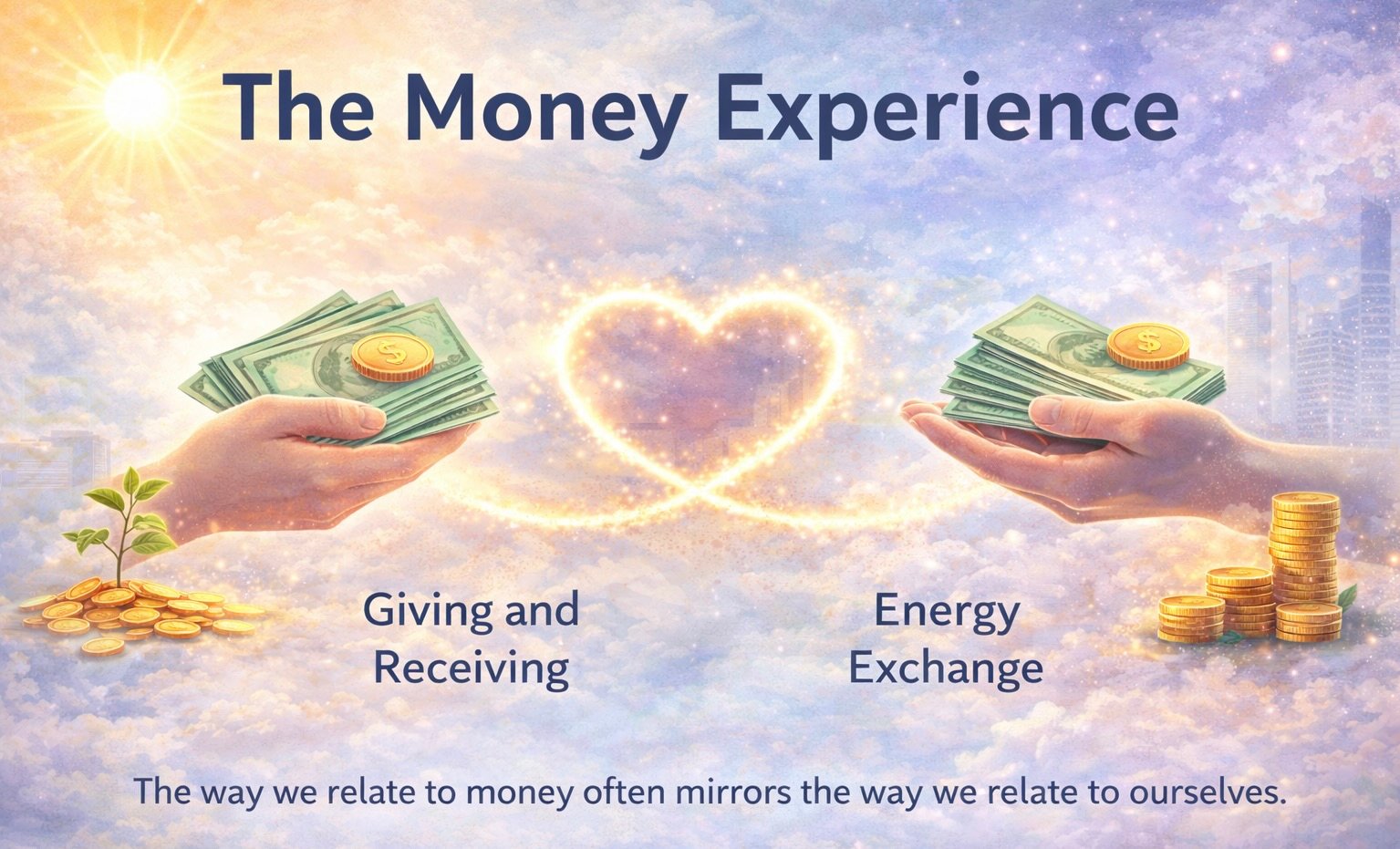
At its core, money represents energy in motion. It reflects effort, time, skill, attention, creativity, and service. Every transaction is an exchange between human beings, whether direct or indirect. When viewed this way, money is not inherently positive or negative; it simply mirrors the inner state, beliefs, and values of those engaging with it.
Many of the challenges people face with money are not financial in nature, but emotional and psychological. Fear-based patterns such as scarcity, comparison, pressure, and insecurity often shape decisions unconsciously. These patterns are usually formed early in life and reinforced through repeated experiences, social conditioning, and unexamined beliefs.
Giving and Receiving
Our experience of money unfolds primarily through giving and receiving.
Giving money in exchange for value, skill, or service is a functional and healthy form of participation in society. This is how most economic systems operate. At the same time, giving without expectation—whether through generosity, support, or contribution—often creates a different internal experience. It shifts attention from accumulation to connection, from control to trust.
Receiving money, on the other hand, is not always as simple as it appears. Many people struggle with receiving fully, carrying unconscious guilt, self-doubt, or fear of loss. Accumulation may provide temporary security, but without inner stability it rarely leads to lasting fulfilment.
A useful reflection is this: the way we relate to money often mirrors the way we relate to ourselves. Self-worth, boundaries, purpose, and inner safety all influence financial behaviour, often more than logic or planning.
Work, Meaning, and Exchange
When work is experienced solely as survival, pressure increases and creativity diminishes. When work aligns with values, contribution, and meaning, money becomes one of several natural outcomes rather than the sole objective.
Throughout history, individuals who focus on service, teaching, creativity, or wellbeing often receive support in multiple forms: income, opportunities, gifts, collaboration, or patronage. These are not guarantees, but observable patterns when trust, clarity, and responsibility are present.
Money then becomes one channel of exchange among many, rather than the centre of life.
A Shift in Perspective
A balanced relationship with money does not require rejecting it, idealising it, or spiritualising it excessively. It begins with awareness.
Observing personal beliefs.
Noticing emotional reactions.
Understanding patterns of fear, control, or avoidance.
Developing clarity around values and contribution.
When fear-based narratives soften, money naturally takes its appropriate place: useful, supportive, and secondary to inner alignment.
Life extends beyond survival and accumulation. When basic needs are met, deeper questions emerge around meaning, expression, connection, and inner peace. This is where the quality of human experience
expands.
Closing Reflection
Money is rarely the true problem. It is often the teacher.
By examining how we think, feel, give, receive, and attach meaning to money, we begin to transform not just our financial experience, but our relationship with life itself.
If you wish to explore your relationship with money from an awareness-based and integrative perspective, you are welcome to connect with us.