
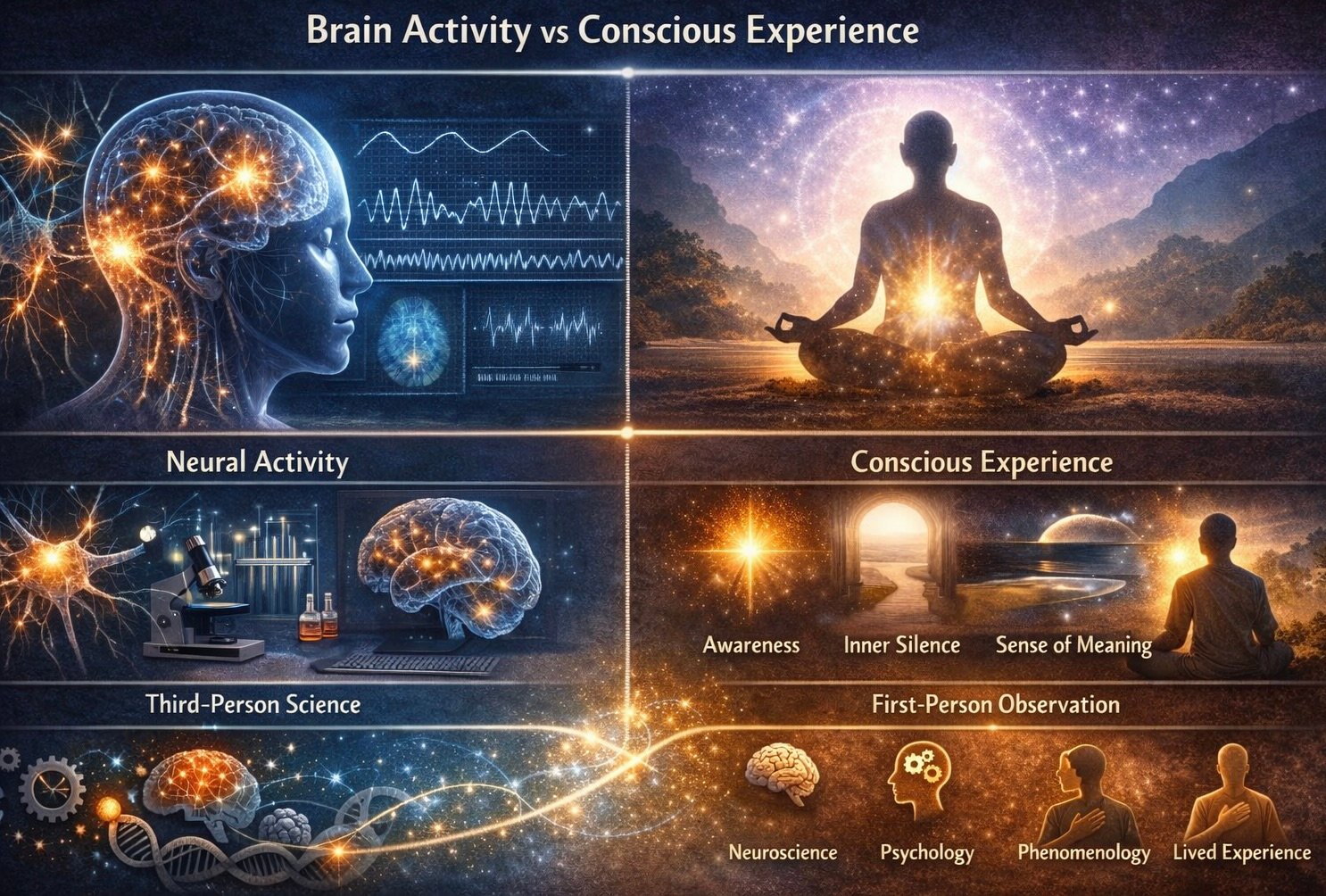
Modern neuroscience has made remarkable progress in mapping brain structures, neural pathways, and electrical activity. Yet one fundamental question remains unresolved: why subjective experience exists at all. While brain scans can show where activity occurs, they cannot fully explain what it feels like to be aware.
This gap between measurable brain processes and lived experience is often referred to as the “hard problem of consciousness.” It is not a failure of science, but a recognition of its current limits.
At YOGA5D, consciousness is approached not as a belief system, but as a direct human experience that complements scientific inquiry rather than competing with it.
Brain Activity vs Conscious Experience
Neuroscience observes:
-
Neural firing
-
Electrical and chemical signalling
-
Functional brain regions
-
Correlations between activity and behaviour
However, correlation is not identity.
The presence of neural activity does not fully explain:
-
Awareness itself
-
Inner silence
-
Meaning
-
Presence
-
Subjective clarity
This distinction is increasingly acknowledged within cognitive science, philosophy of mind, and psychology.
The Role of First-Person Observation
Scientific tools rely on third-person measurement.
Contemplative practices rely on first-person observation.
Both are valid, but they answer different questions.
Meditation, when practiced safely and progressively, becomes a method of structured self-observation, not belief or ideology. It allows individuals to study:
-
Attention
-
Perception
-
Emotional reactivity
-
Mental noise
-
Stillness
YOGA5D integrates this experiential inquiry without making metaphysical or medical claims.
Why Reductionism Has Limits
Reductionism is powerful for studying systems, but consciousness is not merely a system—it is the field in which systems are experienced.
This does not negate neuroscience. It completes it.
Understanding consciousness may ultimately require:
-
Neuroscience
-
Psychology
-
Phenomenology
-
Embodied experience
YOGA5D Perspective
YOGA5D does not attempt to explain consciousness conceptually.
It supports direct, regulated experience, grounded in:
-
Nervous system stability
-
Attention training
-
Body awareness
-
Emotional literacy
This approach respects both science and lived reality.