
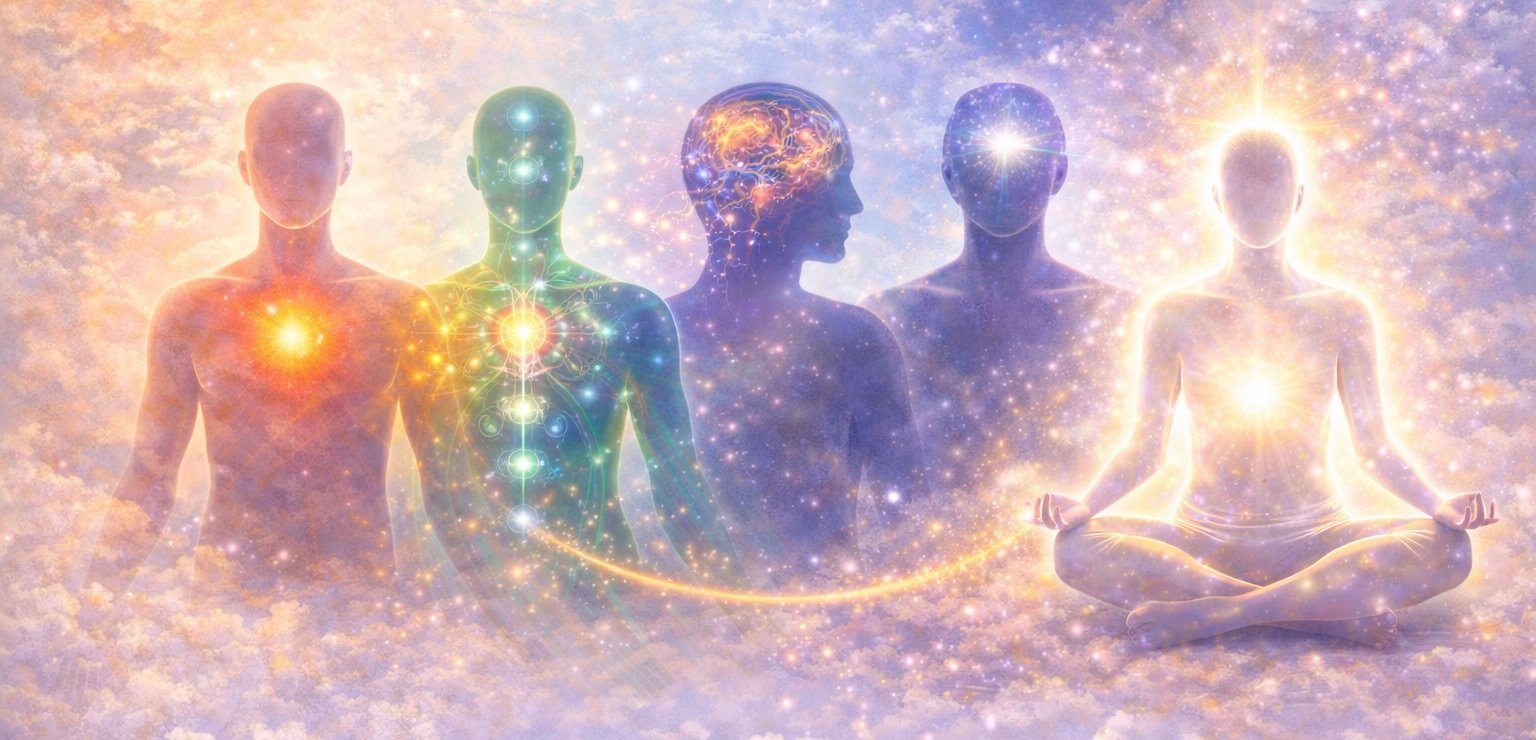
The human experience extends far beyond the physical body alone. According to classical yogic philosophy, our existence is composed of multiple interconnected layers of being, known as the Pancha Koshas—the five sheaths or bodies that function simultaneously.
These layers range from the tangible physical body to the most subtle state of pure awareness. Understanding them offers a deeper perspective on health, emotion, consciousness, and spiritual growth.
1. Annamaya Kosha — The Physical Body
The Annamaya Kosha is the physical body, sustained by food, water, and rest. It is the most visible and familiar layer of our existence, and the one with which we most commonly identify.
Physical symptoms, pain, and disease often appear here as the final expression of imbalance, after subtler disturbances have gone unaddressed in deeper layers. From a yogic perspective, the body communicates through sensation long before breakdown occurs.
Caring for this layer through movement, nutrition, and rest is essential—but it is only the beginning.
2. Pranamaya Kosha — The Vital Energy Body
The Pranamaya Kosha governs life force (prana). It consists of an intricate network of energy channels (nadis) and major energy centres (chakras) that regulate vitality, breath, and internal balance.
Breathing practices, yogic movement, kriyas, and conscious regulation of energy help maintain a smooth and balanced flow of prana. This layer acts as a bridge, connecting the physical body to subtler dimensions of experience.
When energy flows freely, the body and mind naturally move toward equilibrium.
3. Manomaya Kosha — The Mental & Emotional Body
The Manomaya Kosha encompasses thoughts, emotions, memory, and sensory processing. In yogic texts, the mind (chitta) is often described as restless and reactive—constantly shifting in response to inner and outer stimuli.
Thoughts are not random; they often arise from unprocessed emotional impressions stored beneath conscious awareness. Rather than suppressing these emotions, yoga encourages gentle observation and integration.
As emotional awareness increases, mental turbulence gradually settles, allowing clarity, emotional resilience, and inner stability to emerge.
4. Vijnanamaya Kosha — The Intellectual & Discriminative Body
The Vijnanamaya Kosha represents intellect, insight, and discernment. It is the faculty that allows us to observe the mind rather than be controlled by it.
This layer supports ethical clarity, learning, intuition, and the ability to distinguish what is supportive from what is not. In yogic symbolism, it is likened to a swan capable of separating milk from water—retaining essence while releasing distraction.
Here, understanding deepens, patterns become visible, and conscious choice replaces habit.
5. Anandamaya Kosha — The Blissful Body
The Anandamaya Kosha is the most subtle layer of being—often described as the body of bliss, pure awareness, or consciousness itself.
In this state, mental activity quiets, the sense of separation dissolves, and experience is marked by stillness, ease, and profound peace. It is not an emotional high, but a deep, steady presence beyond thought.
This layer is described in yogic traditions as timeless and unconditioned—not something we create, but something we remember.
Integration, Not Escape
The purpose of understanding the five koshas is not to escape the physical world, but to live more fully within it, with awareness of the deeper dimensions that shape our experience.
Yoga, at its core, is the art of integration—aligning body, energy, mind, intellect, and consciousness into a coherent and conscious way of living.