
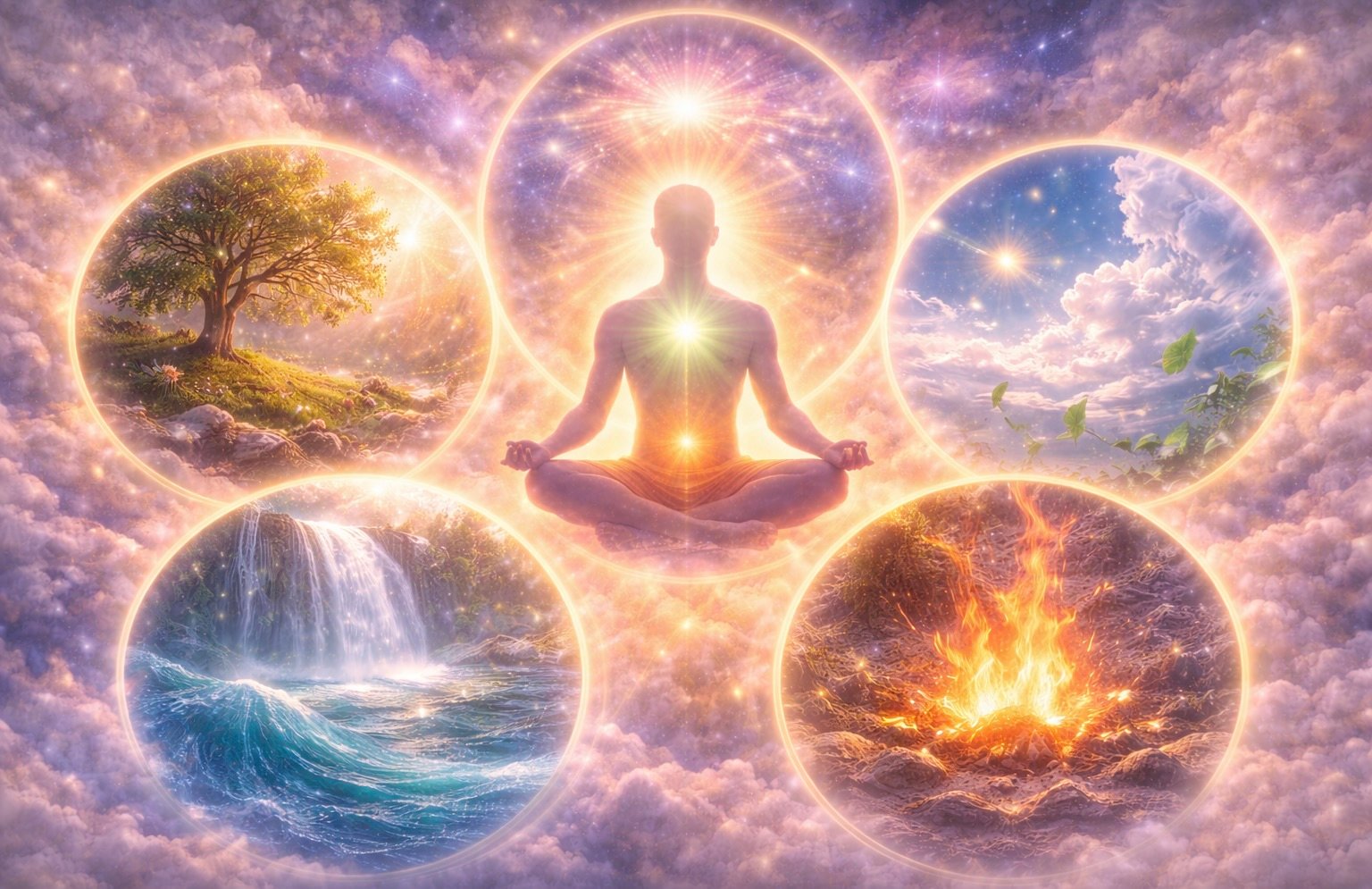
Across cultures and centuries, human beings have observed that existence expresses itself through fundamental building blocks. In yogic and Vedic traditions, these building blocks are known as the Panchamahabhutas—the five great elements: Earth, Water, Fire, Air, and Space (Ether).
Far from being symbolic alone, these elements describe how matter, energy, perception, and experience arise and interact—both in the universe and within the human system.
Modern physics increasingly echoes an ancient insight long expressed in the Vedas: what appears solid, separate, and fixed is in fact dynamic, interconnected, and continuously transforming. At every scale—from subatomic particles to galaxies—form emerges from the same elemental principles.
The human body and mind are not separate from this process. We are expressions of the same elemental intelligence.
The Five Elements in Human Experience
1. Earth Element (Prithvi Tatva)
Earth represents structure, stability, and form. Everything that has mass—bones, muscles, organs, cells, minerals, planets—belongs to this element.
Prithvi Tatva governs grounding, physical resilience, and the capacity to sustain life. The body’s material composition is shaped continuously by what we consume, how we move, and how we relate to gravity and effort.
Earth teaches presence, patience, and reality as it is. When balanced, it supports strength and endurance. When disturbed, it may express as rigidity, heaviness, or disconnection from the body.
2. Water Element (Jala Tatva)
Water embodies fluidity, adaptability, and cohesion. It binds cells together, regulates temperature, transports nutrients, and enables biochemical reactions.
In human experience, water corresponds to emotional flow and adaptability. Like water, emotions move, respond, and change. Resistance creates stagnation; allowance restores movement.
Water reminds us that flexibility—not force—is essential for long-term balance.
3. Fire Element (Agni Tatva)
Fire represents transformation and metabolism. It governs digestion, cellular energy production, temperature regulation, and neurological activation.
Agni is the principle that converts input into usable energy—food into vitality, experience into learning, emotion into insight. Without fire, nothing is processed; with excess fire, systems burn out.
Fire teaches discernment, clarity, and appropriate intensity.
4. Air Element (Vayu Tatva)
Air signifies movement, circulation, and exchange. Breath, nerve impulses, circulation, and sensory transmission all function through this element.
Vayu Tatva connects body and mind. Changes in breath immediately influence mental and emotional states. Restlessness, anxiety, or lethargy often reflect imbalance in this element.
Air teaches responsiveness, rhythm, and the importance of space between actions.
5. Space / Ether (Akash Tatva)
Space is the subtlest and most pervasive element. It provides the field within which all other elements operate.
There is space between atoms, between thoughts, between breaths. Without space, movement, sound, and perception cannot occur.
Akash governs awareness, listening, and the capacity to observe without interference. It allows insight, perspective, and integration.
Elemental Intelligence and Integration
The elements are not separate forces to be mastered; they are interdependent expressions of a single system. Health—physical, emotional, and psychological—emerges when these elements function in harmony.
Imbalance does not imply failure; it signals information. The body and mind continuously communicate through elemental patterns, offering feedback long before crisis appears.
Understanding the Panchamahabhutas is not about belief—it is about perception. It invites a deeper relationship with how life organizes itself, within and around us.
Closing Reflection
What exists in the universe exists in us.
What we observe outside mirrors what operates within.
The five elements are not ancient abstractions—they are living processes shaping every moment of experience.
Awareness of them is not an escape from life, but a return to coherence within it.